
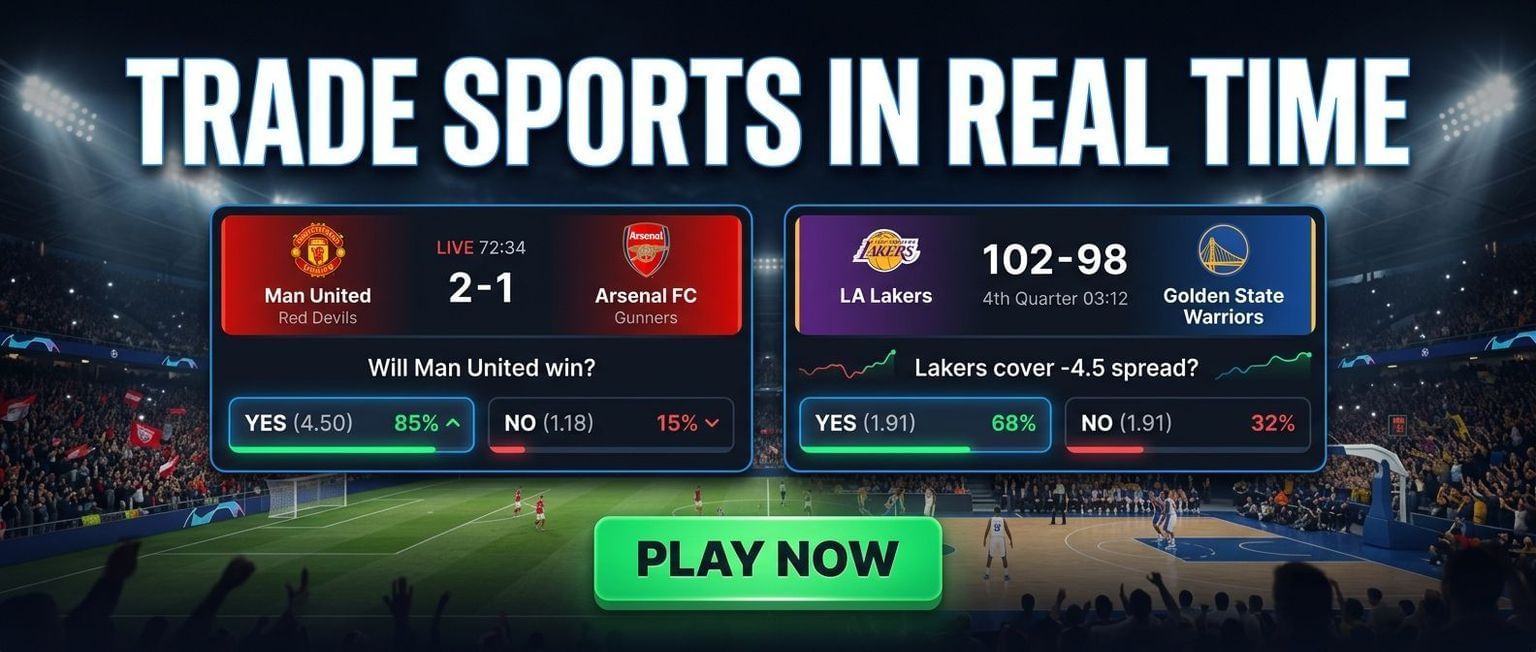
Polymarket Sports Prediction Markets
Polymarket sports prediction markets are a way to trade on sports outcomes using market prices as a real-time signal of what participants collectively think will happen. Instead of placing a traditional sportsbook wager with fixed odds set by a bookmaker, you’re buying and selling “Yes” or “No” positions whose prices move as new information arrives - injuries, weather, lineup changes, and public sentiment can all push prices up or down.
What makes this category matter is how directly it turns opinions into prices. A market price can be read like a constantly updating probability estimate (not a guarantee), and the trading format means you can enter, add, reduce, or exit positions before an event settles.
What makes Polymarket sports markets different from sports betting?
A useful way to frame Polymarket sports markets is “event contracts.” Each market is typically built around a clear, verifiable question such as whether a team wins a game, a fighter wins a bout, or a player reaches a milestone. The contract resolves to a simple outcome: Yes or No.
Sportsbooks generally quote odds and take the other side (or manage risk across many bettors). In a prediction market, participants trade with each other, and the price is shaped by supply and demand. If new information causes many people to want “Yes,” the “Yes” price tends to rise.
Because this is trading, not just one-time wagering, timing matters. You can sometimes lock in gains or cut losses by selling before settlement if the price moves in your favor or against you. That is a core difference in how people use sports prediction markets compared with a standard bet that you simply wait to settle.
The core mechanic: “Yes/No” shares and probability-like prices
Most sports markets on Polymarket can be understood with a simple mental model:
A “Yes” share pays out 1 unit if the event happens, and 0 if it doesn’t. A “No” share pays out 1 unit if the event does not happen, and 0 if it does.
The market price for “Yes” is often treated like an implied probability. For example, if “Yes” trades around 0.65, market participants are collectively valuing that outcome as roughly 65% likely. That’s an interpretation, not a promise, and it can be wrong - especially in thin markets or when news is moving quickly.
Prices change because traders disagree and act on that disagreement. When new buyers push in, “Yes” can climb. When confidence fades, “Yes” can drop as sellers accept lower prices to exit.
Sports market types you’ll commonly see (and how they settle)
Sports prediction markets can cover many formats, but they tend to fall into a few patterns:
Match or game winner markets resolve based on the official result of the contest. If the question is “Will Team A win?” the details matter: does “win” mean regulation only, or including overtime? The market rules specify this, and those details can decide edge cases.
Series or tournament outcomes resolve when the competition ends and the organizer’s official champion is known. These markets can stay open longer and respond to each round’s results.
Player performance and milestone markets settle based on an official box score or recognized statistic. The key is the exact stat source and definition included in the market’s rules (for example, whether a statistic includes overtime, or how a scoring correction is handled).
Season-long awards and standings markets typically resolve based on the awarding body or league’s official announcement. Timing matters here because there can be delays, recounts, or eligibility disputes that affect when an outcome becomes final.
If you’re new to this category, the most important habit is reading the market’s resolution criteria before taking a position. Two markets can sound similar while settling under different definitions.
How a sports trade works on Polymarket, from start to finish
A sports prediction market trade usually follows a straightforward flow:
You choose a market question and decide whether you believe “Yes” is underpriced (too low) or overpriced (too high). If you think it’s underpriced, you buy “Yes.” If you think it’s overpriced, you might buy “No” or sell “Yes” depending on what the interface allows and how you’re managing exposure.
You pick a price and size. A market order generally fills at the best available prices, while a limit order attempts to fill at your chosen price or better. Limit orders can help you avoid unexpected slippage when the price is jumping around due to breaking news.
After your order fills, you hold a position whose value changes as the market price moves. If the market swings in your favor, you can sell to exit early. If it moves against you, you can reduce or close the position before settlement rather than waiting for the final result.
Finally, when the underlying event is decided and the market resolves, positions settle according to the stated rules. If the outcome is “Yes,” Yes shares settle at full value and No shares settle at zero (and vice versa).
For readers who want a broader foundation first, it can help to review the basics on Polymarket prediction markets and then return to sports with the terminology below in mind.
Must-know terminology (explained in plain English)
Liquidity is how easily you can buy or sell without pushing the price around. Higher liquidity usually means tighter pricing and smoother entries and exits.
Spread is the gap between the best available buy price and sell price. Wider spreads increase trading costs in practice because you give up value when entering and exiting quickly.
Order book is the list of buy and sell orders at different prices. In active sports markets, the order book can shift rapidly around key news.
Market depth is how many shares are available near the current price. A market can look active but still have shallow depth, meaning a moderately sized order moves the price a lot.
Slippage is the difference between the price you expect and the actual average price you get, often during volatile moments like lineup announcements.
Resolution is the official determination of the outcome according to the market’s rules. In sports, resolution typically depends on an official scoreboard, stats provider, or league announcement referenced in the rules.
Practical examples that make the pricing idea click
Imagine a market asks: “Will Team A win the match?” If “Yes” trades around 0.60, buying “Yes” is like saying you think Team A’s true chance is higher than 60%. If later news breaks that the opposing team’s star player is out, the “Yes” price might rise to 0.70. If you bought earlier, you could sell at the higher price to exit before the final whistle - but you’re not guaranteed that opportunity at your preferred price, especially if the market is thin.
Now consider the reverse. If you buy “Yes” at 0.60 and the team concedes early, “Yes” might fall sharply. You can hold and hope for a comeback, or you can sell to limit exposure. The key is that the market gives you flexibility, and that flexibility is part of what you’re paying for when spreads widen during chaos.
Resolution rules: where most misunderstandings start
Sports markets can be deceptively simple. Many disputes come from assumptions about what counts as “official.” Common rule-related pitfalls include:
Overtime and extra time: Some questions include all play, others specify regulation only. That single phrase changes everything.
Postponements and cancellations: Markets may have specific conditions for rescheduling, voiding, or using the next available date. Don’t assume a cancelled event automatically resolves one way or the other.
Stat corrections: Official stats can change after the event. Market rules often specify how long corrections can affect resolution.
Team name changes and substitutions: If a player is replaced or a match changes venue, rules may specify whether the original market remains valid.
The safest approach is simple: treat the market rules as the contract. If the rules feel ambiguous, size down or skip.
Costs and constraints to think about before trading
Even when you’re “right,” execution matters. Spreads, slippage, and timing can reduce returns compared with what you might expect from just reading the headline price.
Liquidity varies by sport, league, and how close the event is. Early markets can be less liquid and more jumpy. Near start time, activity often increases - but volatility can increase too.
Also remember that market prices reflect the crowd’s beliefs, not perfect math. Popular teams and big-name athletes can attract biased demand, pushing prices away from what a purely analytical model might suggest. That can create opportunities, but it can also trap traders who confuse popularity with probability.
For readers specifically interested in how this category fits into the bigger platform structure, you may also want the overview of Polymarket sports markets for related sport-wide browsing patterns and common market themes.
Common mistakes smart beginners still make
One frequent mistake is treating the current price as “the truth.” It’s a signal, and sometimes a noisy one. If the market is thin, a small trade can move price dramatically without any new information.
Another is ignoring exit strategy. If your plan requires selling before settlement, you’re implicitly relying on future liquidity and reasonable spreads. In some markets, you might not get out at a fair price when you need to.
A third is trading headlines instead of rules. Two markets might sound nearly identical, but one settles on regulation and the other includes overtime. If you trade the wrong one, your analysis can be correct and still lose.
Finally, many people underestimate how quickly prices adjust. If news is public and obvious, it’s often already reflected in the price by the time you react.
FAQ
No. Prices are best read as an implied probability based on trading activity. They can be informative, but they can also be distorted by low liquidity, sudden sentiment shifts, or participants favoring a popular side.
Often yes, by selling your position back into the market. Your ability to exit efficiently depends on liquidity, spread, and how volatile the market is at that moment.
It depends on that specific market’s rules. Some markets may wait for a rescheduled date, while others may void or resolve under defined conditions. Always check the resolution criteria.
During volatile periods, market orders can experience slippage if there isn’t enough depth near the last traded price. Limit orders can help you control the worst-case fill price.
Start with the market question and the resolution rules, then check liquidity and the spread. If anything is unclear - especially how “win,” “regulation,” or official stats are defined - don’t guess.