
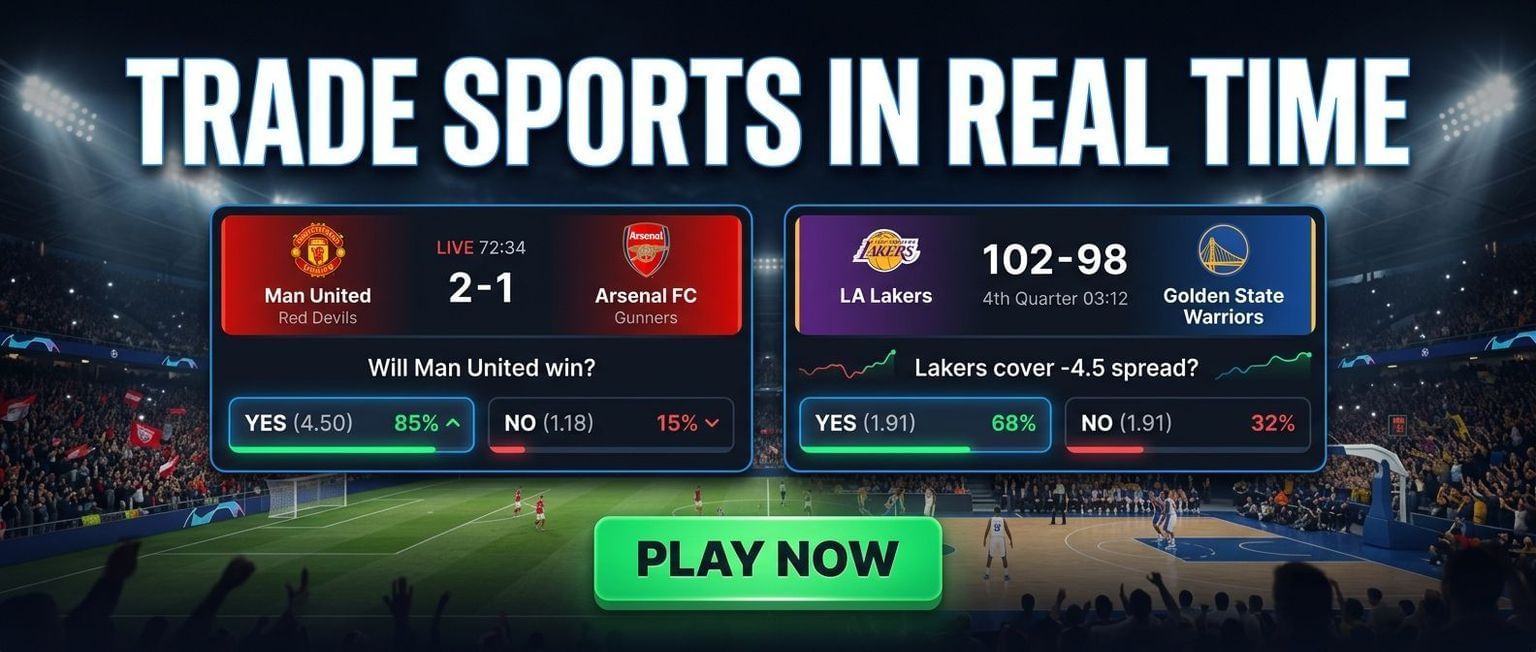
- Identify the outcome tokensOpen a market and identify the outcome tokens (Yes and No). You’re choosing which side you believe will be the resolved outcome.
- Look at the current trading priceLook at the current trading price for Yes (and No). Treat it as the market’s current belief, not a guarantee. If Yes is trading near 0.55, the market is leaning slightly Yes.
- Check the spread and depthCheck the spread and depth before you trade. If the spread is wide or there’s little size available at the displayed price, the odds you see may not be the odds you get for a larger order.
- Decide on your trading approachDecide whether you’re trading to hold to resolution or to trade the price movement. Holding to resolution means you care most about the final outcome. Trading price movement means you also care about timing, liquidity, and how other traders may react to news.
- Consider exit options before enteringConsider exit options before entering. Even if you’re right eventually, you may not be able to exit easily at a good price if liquidity dries up. The odds can be correct in spirit but still hard to trade around.
How Polymarket Odds Work
On Polymarket, “odds” are best understood as market-implied probabilities. Instead of a sportsbook setting a line, traders collectively push prices up and down based on what they think will happen. The result is a live, constantly updating snapshot of the crowd’s belief about a specific yes-or-no outcome.
Why it matters: the “odds” are not just a number to look at - they determine what you pay to enter a position, how much you can get back if you’re right, and what you might receive if you exit early by selling to someone else.
The core idea: price behaves like probability
Most Polymarket markets are simple binary questions such as “Will X happen by Y date?” with two outcomes: Yes and No. Each outcome is represented by a token (a “share”) that pays out if that outcome is the one that resolves as true.
A useful mental model is this:
- A Yes price near 0.70 is commonly read as “about a 70% chance.”
- A Yes price near 0.20 is commonly read as “about a 20% chance.”
This is a convention that comes from how binary shares pay out at settlement (they pay either the full amount or zero). In practice, the market price is a tradable value, so it reflects both beliefs and trading pressure - not a guaranteed “true probability.”
What you’re actually buying: shares that can settle to a fixed payout
When you buy Yes shares, you’re buying the right to receive the settlement payout if Yes is the resolved outcome. If you buy No shares, you receive the payout if No resolves.
At settlement, only one side pays out (for typical binary markets). That’s why a higher price generally means a lower potential return from that point forward - you’re paying more for the same maximum payout at resolution.
How Polymarket prices move: order books and liquidity
Polymarket is a trading venue, so prices move when people place trades. Under the hood, many markets use an order book structure: participants can place bids (prices they want to pay) and asks (prices they want to sell for). Trades happen when a buyer and seller match.
A few practical implications:
- If a market has lots of activity (good liquidity), the displayed price tends to be more stable and it’s easier to trade without pushing the price around.
- If a market is thinly traded, a single large buy or sell can move the price sharply, which can make the “odds” look jumpy.
Because the odds are derived from traded prices, they can change instantly with new information - or simply with shifts in demand.
Key terms that make the odds easier to understand
You’ll run into some prediction-market vocabulary. Here’s what it means in plain language:
Market-implied probability: The probability suggested by the current trading price. It’s “implied” because it’s inferred from what people are paying.
Spread: The gap between the best price a buyer is offering and the best price a seller is asking. A wider spread usually means it costs more to get in and out quickly.
Liquidity: How easily you can buy or sell without noticeably changing the price. Higher liquidity generally means smoother odds and better execution.
Slippage: The difference between the price you expect and the price you actually get, often because your order is large relative to the market or the price moves while you trade.
Settlement / resolution: The process where the market is finalized based on the rules in the market description and an outcome is declared. This is when shares pay out (or don’t).
The simple math intuition: why a 70% market has different payoff than a 30% market
Binary markets are easiest to grasp with a concrete example.
Imagine a Yes share is trading around 0.70. If the market resolves Yes, that share settles at the full payout; if it resolves No, it settles at zero. From a buyer’s perspective, paying 0.70 for something that can become the full payout means the “upside” from settlement is smaller than in a market priced at 0.20 - but it may feel more likely to occur.
Flip it around: if Yes is 0.20, it’s cheaper to buy, so the settlement upside is larger if you’re right - but the market is also signaling it’s less likely.
This relationship is why people often read Polymarket odds as probability: as the market becomes more confident, the price tends to rise.
Step-by-step: how to read Polymarket odds in real time
Practical examples: what different odds “feel like”
A market at 0.90 Yes typically means the crowd sees the outcome as very likely. At that point, the remaining upside to settlement is limited, and a surprise update can still knock the price down quickly.
A market around 0.50 is the purest “coin flip” zone. Small news items, rumors, or data releases can swing the odds because sentiment is balanced.
A market at 0.10 Yes is a long-shot zone. The price can sit low for a long time, then jump sharply if credible evidence appears. This is also where misunderstandings are common - people sometimes confuse “cheap” with “good,” even though the market is explicitly saying it expects the outcome to be unlikely.
How Polymarket’s resolution rules shape the odds
Polymarket odds only make sense when you understand what, exactly, will count as Yes or No. Each market includes a description that defines:
- The precise question being answered
- The deadline or time window
- The sources or criteria used to resolve the market
- Edge cases (for example, what happens if an event is postponed or data is revised)
Two markets can look similar on the surface but resolve differently because the wording differs. Traders who read the rules carefully can interpret odds more accurately and avoid nasty surprises.
If you want a broader grounding in how prediction markets work, it can help to read a general explainer like what is Polymarket once, then come back to odds with that context.
Important mechanics and limitations that can affect “odds”
Odds on Polymarket are not the same as a polling average or an official forecast model. A few factors can distort or complicate the interpretation:
Low liquidity can exaggerate moves. If very few traders participate, the price may reflect the last trade more than a stable consensus.
News latency and narratives matter. Prices can move on rumors, partial information, or misread headlines, then reverse when details are confirmed.
Large orders can temporarily push price. This isn’t necessarily “new information” - it can just be someone taking a position.
Resolution risk exists. Even when the real-world event seems clear, the market can resolve based on its stated sources and rules. Traders price in that rule-based uncertainty.
Time affects behavior. As a deadline approaches, markets may become more sensitive to updates, and the cost of being wrong (or late) is felt more immediately in price.
Common mistakes people make when reading Polymarket odds
One common misunderstanding is assuming the displayed price is a perfect probability. It’s a tradable price, influenced by who shows up to trade, how confident they are, and how much capital they commit.
Another is ignoring the exact resolution criteria. Traders sometimes buy “Yes” because they believe the event will happen in general, but the market might be asking about a specific date, definition, or data source.
People also mix up “chance” with “value.” A higher-probability outcome can still be a poor trade if the price already reflects that probability strongly, while a lower-probability outcome can be a reasonable trade if you believe the market is underestimating it. Neither is “better” by default - it depends on your view versus the market price and how you manage risk.
Finally, many new users underestimate execution details like spread and slippage. If you’re paying meaningfully above the displayed price to get filled, you’re effectively accepting worse odds than you think.
Odds across market categories: what tends to be different
While the pricing logic is consistent, different categories often behave differently:
- Politics markets can react sharply to polls, debates, court decisions, and breaking news, with sentiment swings and occasional overreactions.
- Crypto and finance markets may incorporate fast-moving price feeds, macro announcements, and weekend volatility, which can cause rapid repricing.
- Sports-style questions (when available as prediction markets) often converge as the event nears, but late information like injuries can still move odds.
- Technology and entertainment markets can be especially sensitive to rumor cycles and unclear definitions, making careful reading of resolution rules even more important.
The key takeaway: odds are always “price-as-belief,” but the reliability of that belief depends heavily on clarity of rules and the quality of participation.
Polymarket Odds: Your Questions Answered
They’re best treated as market-implied probability - a live estimate created by trading activity. It can be informative, but it’s not guaranteed to be correct.
Low liquidity, a large order, or traders reacting to social posts and rumors can move the price. Not every move reflects verified information.
Often they’ll be close to summing to 1, but spreads, fees, and order book conditions can create small gaps or inefficiencies depending on how the market is trading.
Not necessarily. In many cases you can exit early by selling your shares to other traders, though your exit price depends on liquidity and the current market price.
Read the market’s resolution criteria and timeline. The odds only have meaning relative to the exact rules that determine how the market will be settled.