
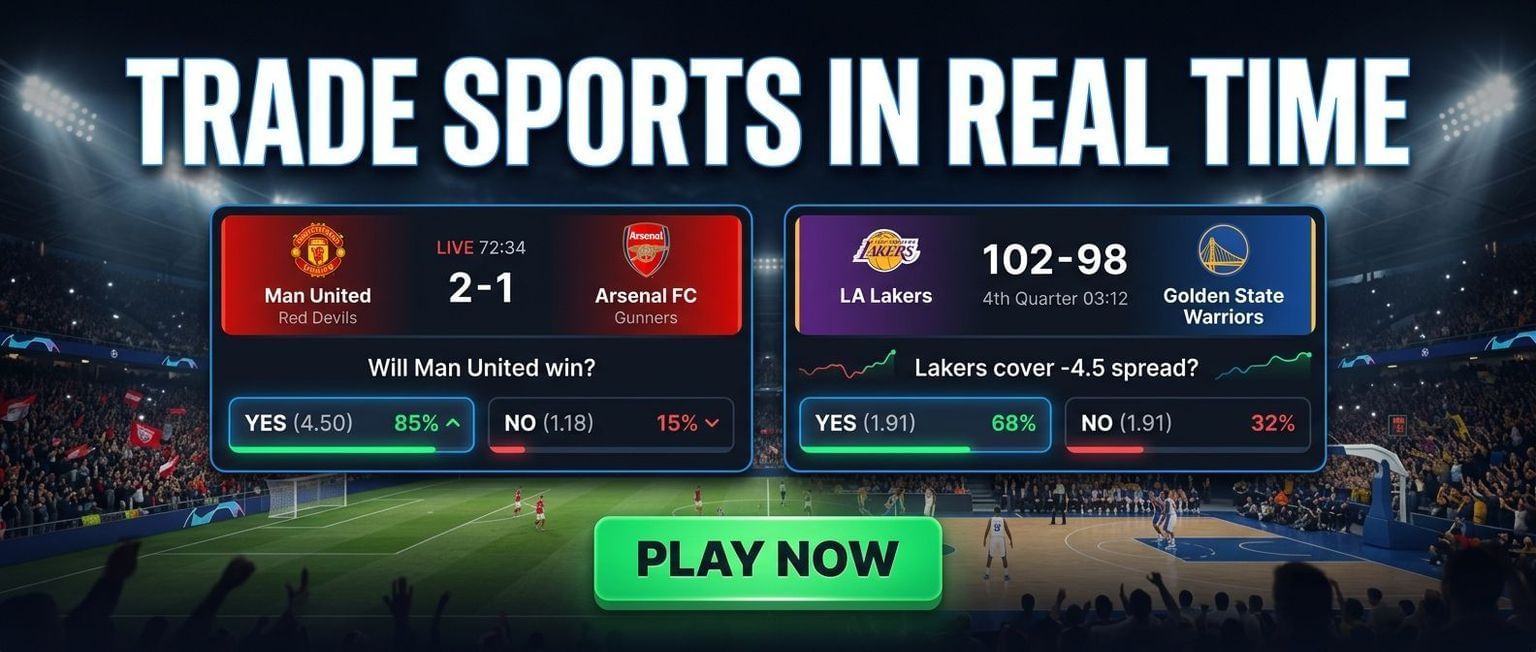
- Choose a market and open itDon’t trade from a headline alone - open the market details.
- Read the resolution rulesConfirm you understand what would make Yes win and what would make No win.
- Decide what you’re trying to doBuy Yes if you want exposure to the Yes outcome. Buy No if you want exposure to the No outcome. Some users also trade by selling existing shares to reduce exposure or lock in gains or losses.
- Choose your order methodIn many trading apps, you’ll see options like a quick trade at the current available price or a limit-style trade where you set the maximum you’ll pay or minimum you’ll accept.
- Enter your amount and review the previewCheck the number of shares, estimated cost, and any displayed fees or price impact carefully.
- Confirm the trade and monitor your positionYour open positions are typically shown in a portfolio area where you can see your average entry price and current market value.
How to Use Polymarket: Beginner’s Guide
Polymarket is a prediction market platform where people trade on the outcome of real-world questions - things like elections, economic indicators, policy decisions, sports outcomes, or tech milestones. Instead of placing a traditional wager against a bookmaker, you’re trading in a market where prices move based on what participants collectively believe will happen.
Why that matters: a market price can act like a real-time “crowd probability.” If a “Yes” outcome is priced at 0.65 (65 cents), many users interpret that as roughly a 65 percent chance - not a guarantee, but a useful signal that updates as new information arrives.
Polymarket can be used for different goals. Some users want exposure to an outcome (hedging). Others want to express a view (speculation). Many simply track prices to see how sentiment shifts as news breaks.
The Core Mechanic: Outcomes, Shares, and Market Prices
Most Polymarket markets are framed as a question with clear outcomes, commonly Yes or No. You trade “shares” of an outcome.
A simple way to think about it:
- A Yes share is worth $1 if the answer resolves Yes, and $0 if it resolves No.
- A No share is the opposite: worth $1 if the answer resolves No, and $0 if it resolves Yes.
Before resolution, shares trade at market prices between $0 and $1. If Yes shares trade at $0.65, buying 10 Yes shares costs about $6.50 (plus any applicable fees). If the market later moves to $0.80, you could sell those shares for about $8.00 (again, fees can apply). If the market resolves Yes, each share pays out $1 at settlement.
This “$0 to $1” pricing is why users often talk about prices like probabilities, even though the price is ultimately a tradable market value that can overshoot or lag behind reality.
Key Terms You’ll See on Polymarket (And What They Mean)
You’ll understand Polymarket much faster if you translate the common terms into everyday language.
A “market” is a single question you can trade, such as “Will X happen by date Y?”
An “outcome” is one of the possible answers (often Yes or No).
“Shares” are the units you buy or sell for an outcome. They settle to $1 if correct and $0 if not.
“Price” is what you pay per share right now. Many users interpret it as an implied chance, but it’s still a market price.
“Liquidity” is how easy it is to trade without moving the price too much. Thin liquidity can mean bigger price jumps.
“Spread” is the gap between the best price someone is willing to buy at and the best price someone is willing to sell at. Wider spreads generally mean higher trading friction.
“Resolution” is the final decision of which outcome is correct, based on the market rules and the specified source(s).
“Settlement” is the payout process after resolution, when winning shares pay out and losing shares become worthless.
Before You Trade: Learn to Read a Market’s Rules Like a Pro
The single most important beginner skill on Polymarket is reading the market’s resolution details. The title is a summary, but the fine print determines what actually counts.
Pay close attention to:
- The exact deadline or time window (especially for “by X date” questions).
- The resolution source (for example, an official announcement, a specific data provider, or a named publication).
- How edge cases are handled (postponements, recounts, revised statistics, overtime rules, substitutions, etc.).
- Whether the market uses a specific timezone.
Many user mistakes come from assuming the “obvious” interpretation rather than the written resolution criteria.
Getting Started: Account Setup and Access Basics
Polymarket involves identity, custody, and access considerations that can vary over time and by region, so rely on what the platform currently displays during signup. In general, you’ll go through:
Account creation, where you set login credentials and security options.
Verification steps, if required, which may include confirming identity. Requirements can change depending on location and policy updates.
Wallet and funding setup. Polymarket is built around crypto rails, so you typically need a compatible wallet and a way to fund it. If you’re new to wallets, treat them like a keychain - if you lose access to the keys or recovery method, you can lose access to funds.
If you want a refresher on prediction-market fundamentals before going deeper, see Prediction Markets Explained.
Funding Your Polymarket Wallet: What “On-Chain” Really Means (Without the Jargon)
Polymarket uses blockchain-based assets for deposits, trading, and withdrawals. The practical takeaway for beginners is simple: you must send the right asset on the right network to the right address.
Common funding pitfalls include:
Sending the correct token on the wrong network. A transfer can fail or become difficult to recover.
Copy-paste errors. Always verify the full address, not just the first and last few characters.
Rushing confirmations. Blockchain transfers can take time, and deposits may require confirmations before becoming tradable.
If Polymarket offers multiple funding methods, pick the one you can execute confidently and verify every detail shown in the deposit flow.
Placing Your First Trade: A Clean Step-by-Step Walkthrough
When you’re ready to trade, use a process that reduces mistakes:
A Practical Example: Turning “Market Price” Into Meaning
Imagine a market: “Will Candidate A win the election?”
- Yes shares trade at $0.58.
- No shares trade at $0.42.
A common interpretation: the market is implying about a 58 percent chance of Yes. If you buy 100 Yes shares at $0.58, you pay about $58. If the market later shifts to $0.70, those shares could be sold for about $70, realizing a gain before the outcome is known (fees may apply). If the final result is Yes, each share pays $1 at settlement, so the gross payout would be $100.
Two important clarifiers: Market prices move constantly with news, polls, and positioning. A temporary price move is not the same thing as being “right.”
You don’t have to hold until resolution. Many users trade in and out as the price changes, but that also introduces timing risk.
Managing Positions Without Guesswork: Exiting, Reducing Risk, and Staying Organized
The simplest risk control on Polymarket is sizing. Decide how much you’re comfortable risking on a single idea and stick to it.
From there, managing a position usually means one of three actions:
Hold to resolution if you want pure exposure to the final outcome and you’re comfortable with the wait and uncertainty.
Sell to exit if your view changes or you want to stop risk. You can sell all shares to close the position or sell part to reduce exposure.
Rebalance if you’re using markets as a hedge. For example, a business affected by a policy decision might use a related market to offset some downside risk. This requires careful thinking about whether the market outcome really matches your real-world exposure.
If you’re tracking multiple positions, write down why you entered each one and what evidence would make you exit. This prevents “I’ll just wait” from becoming your default plan.
What Happens at Resolution: How Polymarket Decides Winners
Resolution is the moment the market outcome becomes official on the platform. Polymarket markets specify a resolution source and criteria. Once the outcome is determined, settlement follows: winning shares are valued at $1 each and losing shares at $0.
Because resolution depends on predefined sources, timing can differ from when you personally feel the answer is obvious. For example, an event might “seem decided,” but the market may wait for an official certification, final score ruling, or published dataset update if that’s what the rules require.
If you’re trading markets tied to categories like politics or macro indicators, this is especially important - official data revisions and formal announcements can matter more than early projections. For a broader overview of market categories you may see, you can also read Politics Prediction Markets once you’re comfortable with the basics.
Fees, Spreads, and Slippage: The Hidden Costs Beginners Miss
Even when a market looks straightforward, your real cost isn’t only the share price.
Spreads can quietly eat into returns. If you buy at the ask and immediately sell at the bid, you’ll likely lose money even if the “probability” hasn’t changed, simply because of the gap.
Slippage happens when your trade is large relative to liquidity, pushing the price against you. The interface may show estimated price impact for this reason.
Fees can apply depending on how the platform currently structures trading and settlement. Because fee schedules can change, check Polymarket’s current disclosures inside the trading interface or help section rather than relying on third-party numbers.
Common Mistakes That Cost Users Money (And How to Avoid Them)
The most frequent issues are surprisingly basic:
Not reading the resolution rules. This is the number one cause of “I was right but lost.”
Confusing price movement with correctness. A position can be “up” today and still settle at $0 later.
Overreacting to headlines. Markets can whip around on early reports and then reverse when better information arrives.
Ignoring liquidity. Thin markets can trap you in a position where exiting costs more than expected.
Putting too much into one market. Concentration makes outcomes emotionally harder to handle and increases the odds of a single surprise ruining your week.
Forgetting time. A market that resolves months from now ties up capital and attention. Make sure the timeline matches your purpose.
Smart Ways to Use Polymarket as a Beginner (Without Overcomplicating It)
Start with markets that have clear criteria and well-defined sources. Yes/No questions with objective outcomes are generally easier to evaluate than ambiguous ones.
Trade small at first. Your early goal is learning the mechanics: reading rules, placing orders, and understanding how prices move.
Treat the price as information, not certainty. A 70-cent Yes share doesn’t mean “it will happen,” it means “this is what the market is pricing right now.”
Keep a simple routine: read rules, plan size, enter carefully, and know what would make you exit.
FAQ: Quick Answers to Common Polymarket Questions
Yes. You can typically exit by selling your shares back into the market at the current available price, subject to liquidity and spreads.
Not necessarily. It’s a tradable price shaped by information, sentiment, and positioning. Many people interpret it like a probability, but it can be wrong or temporarily distorted.
It means there aren’t many active buyers and sellers. Prices may jump more, spreads may be wider, and it can be harder to enter or exit at a fair price.
If you placed an order that requires a matching counterparty at your chosen price, it may wait until the market reaches that level. Market conditions and liquidity affect fill speed.
The market’s written rules and resolution source control the outcome. Always check how edge cases are handled in that specific market.
No. You can potentially profit (or lose) from price changes by trading in and out before resolution, but that adds timing risk and trading friction.